
Internet of Things Automation with Real-Time GPS Trackers
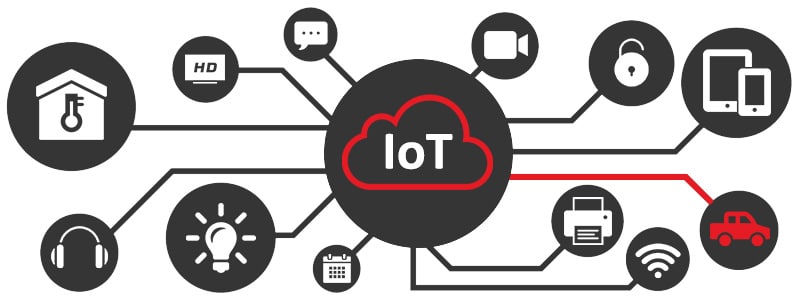
The dream of an automated future, a future painted so vividly in science fiction pulp from yesteryear, is finally upon us. From thermostats learning about your temperature preferences and automatically adjusting to your presence, to front door locks automatically unlocking while the lights turn on, announcing your arrival home. These ideas, once considered fantasy, are slowly becoming commonplace and the backbone of this automated future is The Internet of Things (IoT).
If you’re not familiar with the IoT, the simplest definition is that everyday devices – light bulbs, refrigerators, televisions, and more – now have the ability to connect to one another. Your fleet vehicles are no exception.
REAL-TIME GPS TRACKERS
With real-time GPS trackers, your fleet vehicles become a part of the IoT, opening up a new world of potential automation. Wouldn’t it be great to receive a text message notifying you that your driver reached their destination? Or automatically send a driver the gate code to the neighborhood they’ve just approached? Leveraging the power of a connected vehicle to automate common tasks is a core feature of GPS Insight and one that can provide tremendous value.
The possibilities are endless. Never lose track of when your tires need to be rotated or when you need an oil change with maintenance alerts. Find out immediately if your vehicle is moving when it’s not supposed to with odd-hours alerts. Real-time GPS trackers empower countless ideas for automation.
TESTING OUT DIFFERENT AUTOMATION
As a proof of concept, through our alerting functions and the free web-based service IFTTT, we have been able to do some more unique forms of automation. Here are some of the fun, unusual connections we were able to create.
- Change multi-color LED lights (i.e. Philips Hue) in your home or office to red when a specific vehicle is speeding.
- Turn on the heater (via Nest Thermostat) in the office as you leave home to ensure it’s nice and cozy when you arrive.
- Play Sammy Hagar’s “I Can’t Drive 55” on the office computer when a specific vehicle speeds.
The Future of IoT for Fleets
Real-time GPS trackers are just scratching the surface of what’s possible for fleets that want to add IoT capabilities.
Self-driving vehicles present one of the biggest opportunities. In 2019, a self-driven semi hauled a trailer full of butter 2,800 miles aross the US. At that point, companies competing in the self-driving space employed nearly 2,000 people. That’s certainly a sign of things to come in the self-driving space.
Business analytics are another way the IoT is sure to expand beyond real-time GPS tracking. Automated inventory tracking will end the days of employees spending time combing through warehouses to find items. The IoT will also optimize energy use.
This means huge savings of time and money.